




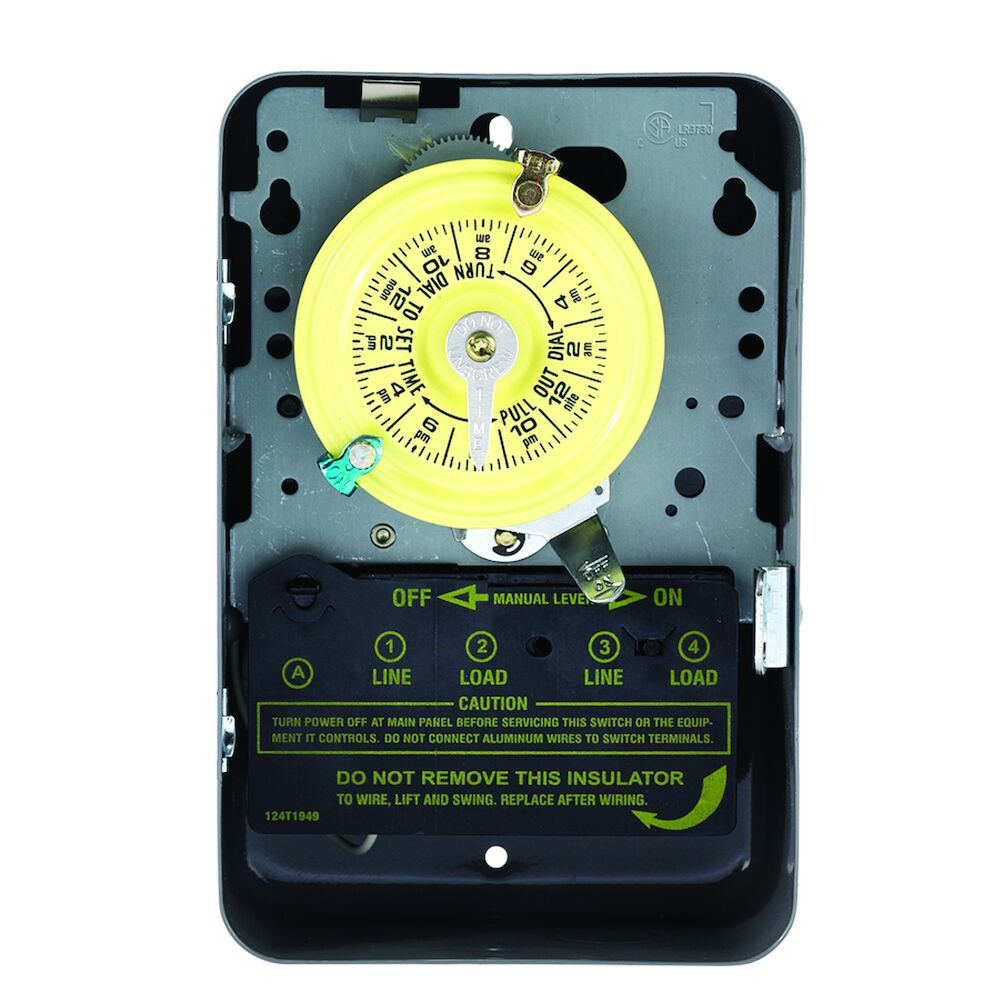
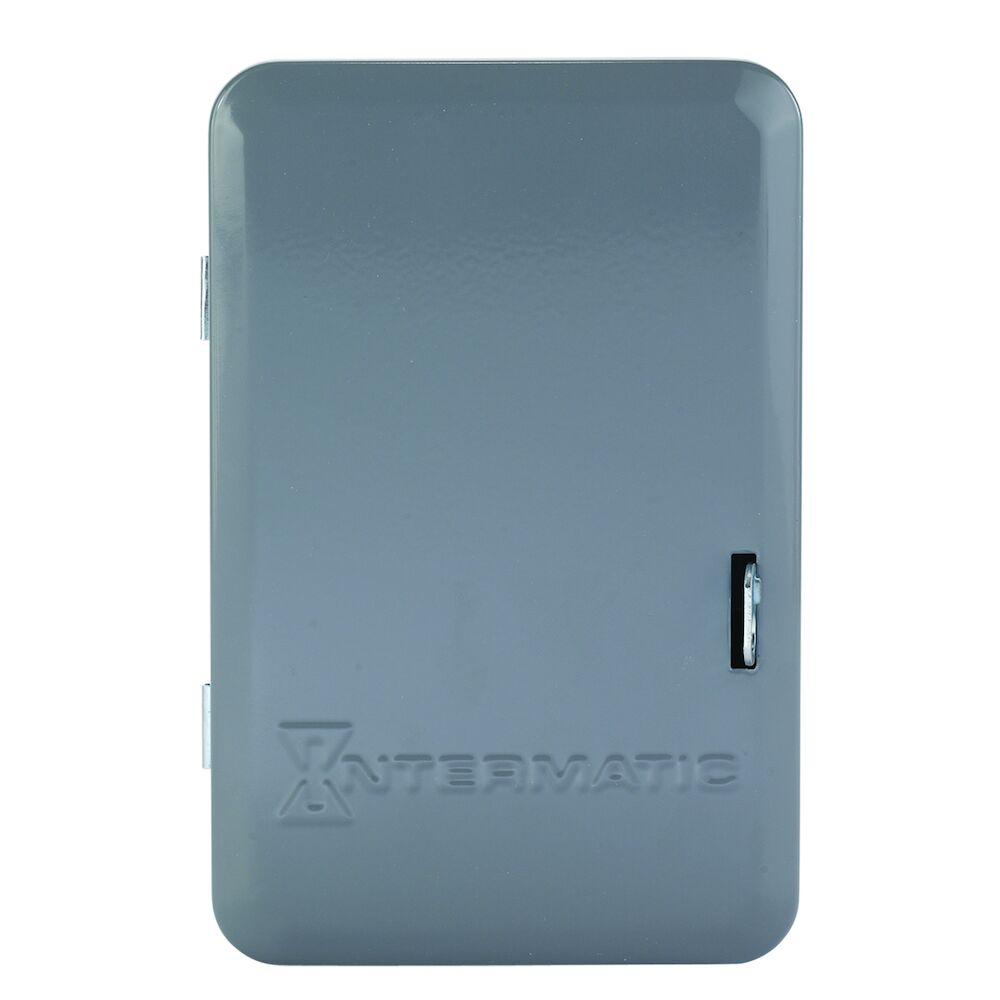
INTERMATIC T103 Electromechanical Timer, 24-Hr Time Setting, 125 VAC, 40 A, 5 HP
Ships within 2 days via
Payment
- Specifications
- Product Details
- Shipping Information
- Working Mechanism
- Features
- Compatible Accessories
- FAQ′s
- See Variants
Specifications
| Item | Electromechanical Timer |
|---|---|
| Amps | 40A |
| Applicable Ac Voltage Ranges | 120V AC |
| Application | Lighting |
| Body Color | Gray |
| Body Material | Metal |
| Compatible Lighting | HID, LED |
| Contact Form | DPST |
| Contact Hp @ 120v | 2 hp |
| Contact Hp @ 240v | 5 hp |
| Current Rating | 40A |
| Day Skipper | No |
| Depth | 3" |
| Description/special Features | Furnished With A Maximum Of 1 Trippers, Manual On/Off Override Does Not Alter Program, Snap-Out Timing Mechanism, Up To 12 On/Off Settings Per Day |
| Display Qty | 1 |
| Enclosure Type | Steel |
| Features | Teeter Type Terminals |
| Finish | Enamel |
| Has Manual Override | Yes |
| Has Manual Override Cvl | Yes |
| Height | 7 13/16" |
| Horsepower @ 120v - Maximum | 2 hp |
| Horsepower @ 240v - Maximum | 5 hp |
| Indoor/outdoor | Indoor |
| Indoor/outdoor Usage | Indoor |
| Length | 7 4/5" |
| Max. On/off Cycles | 12 |
| Maximum Power Consumption | 3 W |
|---|---|
| Min. Time Setting | 1 hr. |
| Minimum On Off Time | 1 hr. |
| Minimum On/off Times | 1 hr. |
| Mounting | Hole Wall |
| Mounting Style | Surface |
| Nema Enclosure Rating | 1 |
| Number Of Circuits | 1 |
| Number Of Poles | 2 |
| Number Of Trippers - Maximum | 2 |
| Number Of Trippers Included | 2 |
| Operating Temperature - Maximum | 130°F |
| Operating Temperature - Minimum | -40°F |
| Overall Depth | 3 7/16" |
| Overall Height | 7 7/8" |
| Overall Width | 5 1/8" |
| Power Consumption Max W | 3 W |
| Product Type | Timer |
| Series | T100 Series |
| Skipper Wheel | Not Included |
| Skipper Wheel Operation Mode | Not Included |
| Time Setting - Max. | 24 hrs. |
| Time Setting - Maximum | 24 hrs. |
| Timing Interval | 1 hr. |
| Width | 5" |
| Wiring Option | Terminals |
| standard | CCSAUS, CULUS |
Product Details
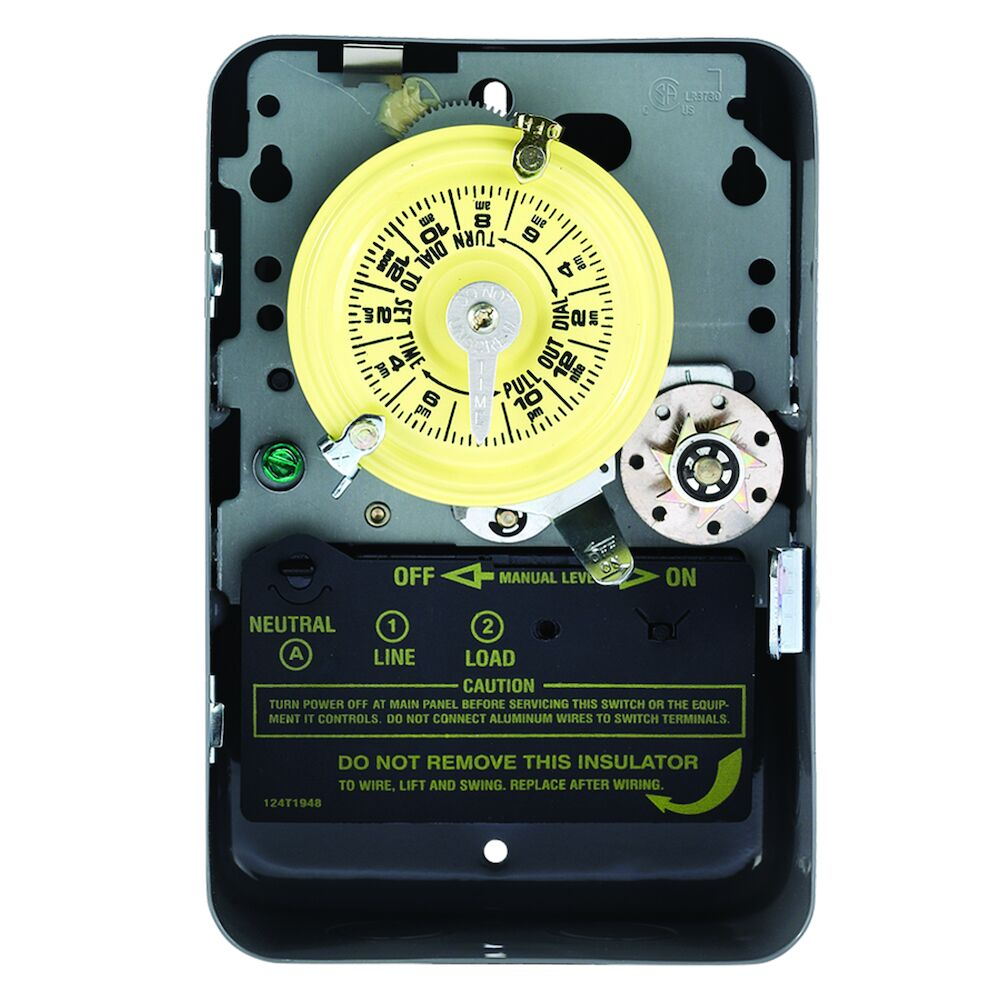
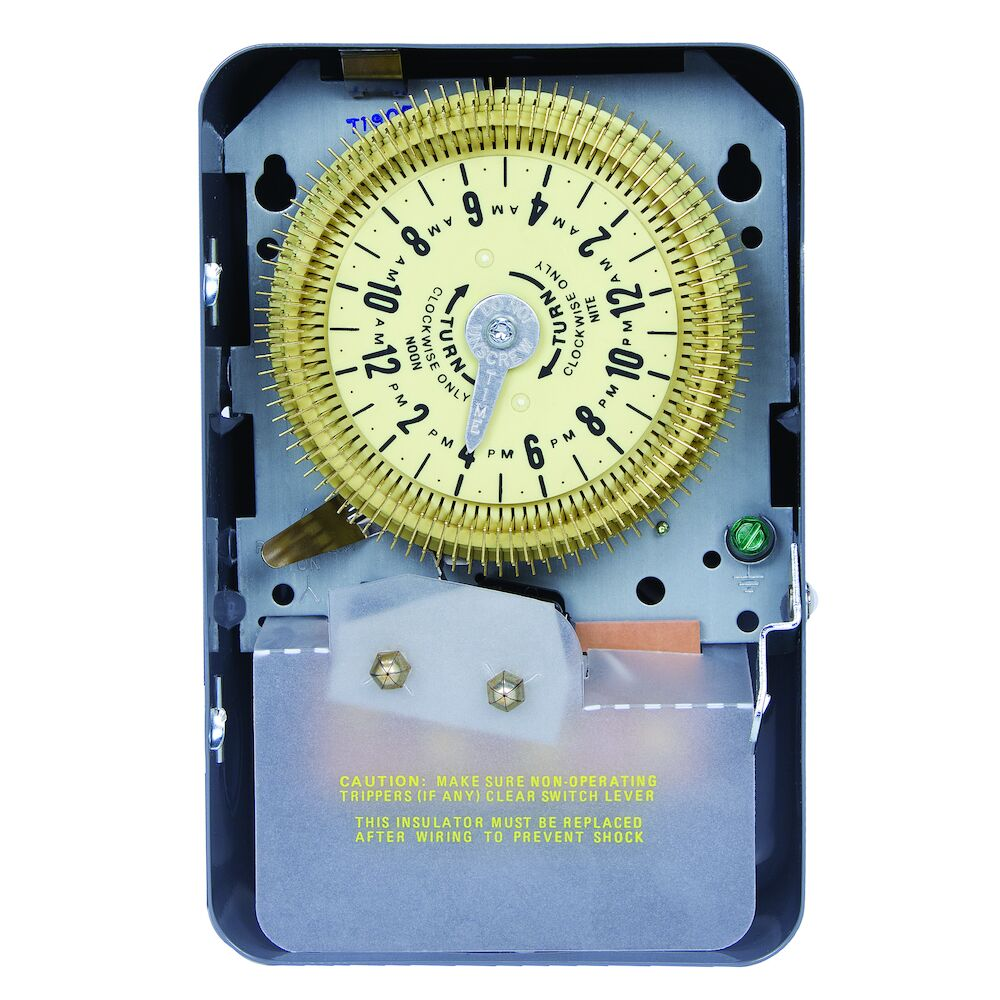
Intermatic T103 electromechanical timer automates the activation and deactivation of electrical circuits for controlling lighting, pumps, heaters and other equipment. By enabling users to pre-program ON / OFF schedules, it enhances energy efficiency, security and convenience.
Shipping Information
| Height | 20 |
|---|---|
| Length | 8.73 |
| Width | 13.02 |
| HS Code | 9106905510 |
|---|---|
| Country Of Origin | MX |
| Weight | 1.234800 |
Working Mechanism
- The timer houses a clock mechanism that runs on electricity. This clock is responsible for tracking time intervals.
- Users set specific time intervals on the timer. These intervals determine when the connected devices should turn on or off.
- The timer motor is also electrically powered that drives the clock mechanism. It advances the clock by rotating a small gear.
- The timer has multiple switches that control the ON / OFF state of connected devices. Trippers and small plastic tabs are inserted on the timer dial next to the desired on / off times.
- As the timer motor turns the clock, the dial with trippers also rotates. When a tripper encounters a switch, it pushes or releases the switch based on its position.
- When a tripper on the dial pushes a switch, it closes the electrical circuit. This allows electricity to flow to the connected device, turning it on.
- As the dial continues to rotate, a tripper on the dial may release a switch. Releasing the switch breaks the circuit, cutting off electricity to the device and turning it off.
Features
- Intermatic T103 electromechanical timer has a snap-out timing mechanism that simplifies setting adjustments, while the included and additional E054 trippers allow fine-tuning of the timer's ON / OFF schedule.
- It has a manual override that ensures that the set program remains intact while enabling immediate manual control when needed, offering a balance between automation and manual intervention.
- This T103 timer has a steel enclosure with gray enamel finish for resisting corrosion on exposed surfaces and durability.
- It has mounting holes for easy installation on the wall and a 2 pole configuration to enable independent control of two separate circuits.
- This electromechanical timer supports up to 12 ON / OFF cycles per day, enabling intricate scheduling for applications that require frequent changes in operation, such as lighting or heating control.
- It features a high horsepower rating, thereby making it suitable for resistive loads up to 40A per pole at 125V.
- This T103 electromechanical timer features a manual overriding facility that doesn't alter the preset programming.
- It has teeter-type terminals for numerous load connections and can be easily installed in most Intermatic enclosures.
Compatible Accessories
- Intermatic WG1570 Time Clock Motor: It serves as a replacement or spare motor for the T103 electromecaniscal timer, ensuring the accurate and reliable operation of the timer's clock mechanism. The WG1570 motor maintains the functionality of the timer, driving the clock mechanism that controls the on / off schedules of connected devices.
- Intermatic T103M Dial Timer Mechanism: This replacement or supplementary dial mechanism ensures precise and reliable time tracking for the timer. The T103M dial timer mechanism integrates flawlessly with the timer's existing setup, enabling users to maintain accurate control over on / off schedules.
- Intermatic 156T1961A Tripper Timer: This tripper serves as replacements or additions to the T103M timer, ensuring accurate and customisable scheduling of ON / OFF cycles. It seamlessly integrates with the timer's mechanism, allowing users to set precise timings for various devices.
FAQ′s
Q. Do mechanical timers consume electricity?
A. The average mechanical timer uses 1 Watt per hour which translates to 24 Watts daily. Typically, a digital timer uses a little bit more energy. About 2 Watts per hour of power are used here.
Q. What are the three main types of timers?
A. The three major types of PLC timers are on-delay, off-delay and retentive on-delay.
Q. What benefits do an electronic timer have over a mechanical one?
A. Both of them operate similarly and are capable of carrying out the same tasks. A mechanical timer is typically constructed as a massive, grey, metal box that may stand out significantly in your home's decor. Mechanical timers are typically larger, last longer and can take more electrical load than a digital timer.
Q. What maintenance is required for this Intermatic T103 timer?
A. Regularly check for proper alignment of trippers and keep the timer clean from dust and debris.
Q. Does this timer help save energy in lighting systems?
A. Yes, by automating lighting schedules, it helps save energy by preventing unnecessary usage during off-peak times.
Q. What is the purpose of the manual on / off override in the T103 timer?
A. The manual override allows immediate control of devices outside the programmed schedule without affecting the set program.
Q. How to surface mount this timer?
A.
- Remove the cover and remove two screws on opposite corners.
- Remove the housing that encases the time switch and the terminal cover away from the base.
- Place a screw through pre-set holes in the base and screw it to the back of the panel or wall.
- Replace the terminal cup and push the timer firmly onto the base.
- Attach the housing and secure it with screws.
Q. Does Raptor Supplies offer other Intermatic electronic timers?
A. Yes, customers looking for electronic variants can choose from Intermatic SPST electronic timers having astronomic programming that offers sunset ON and sunrise OFF settings, eliminating the requirement for separate photo control devices.
Related Products
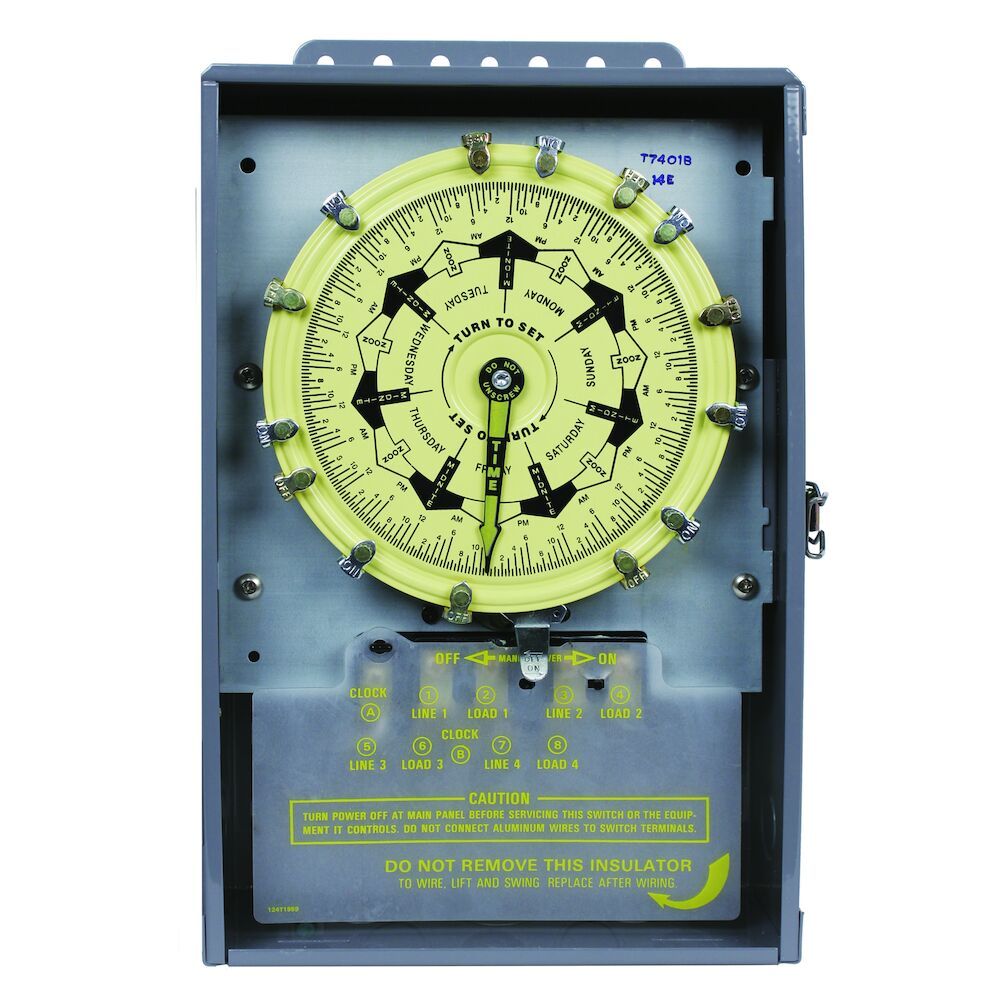
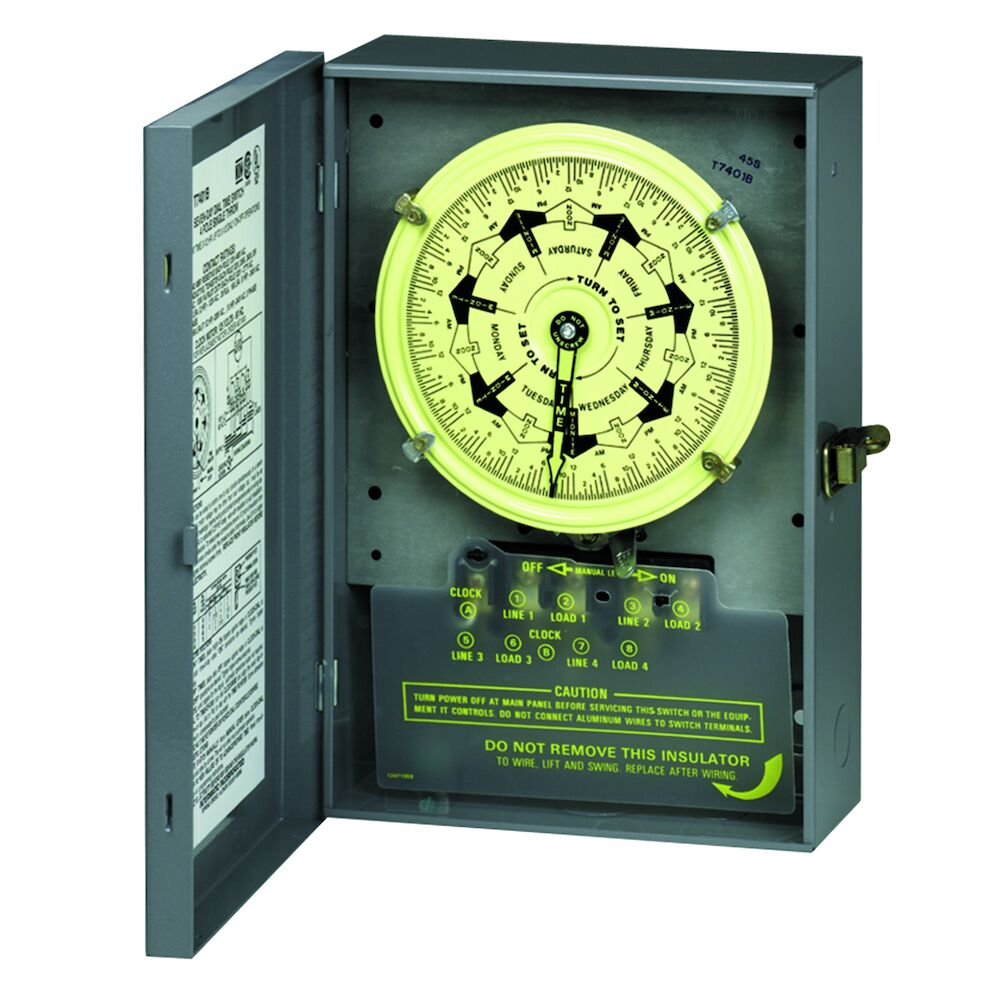
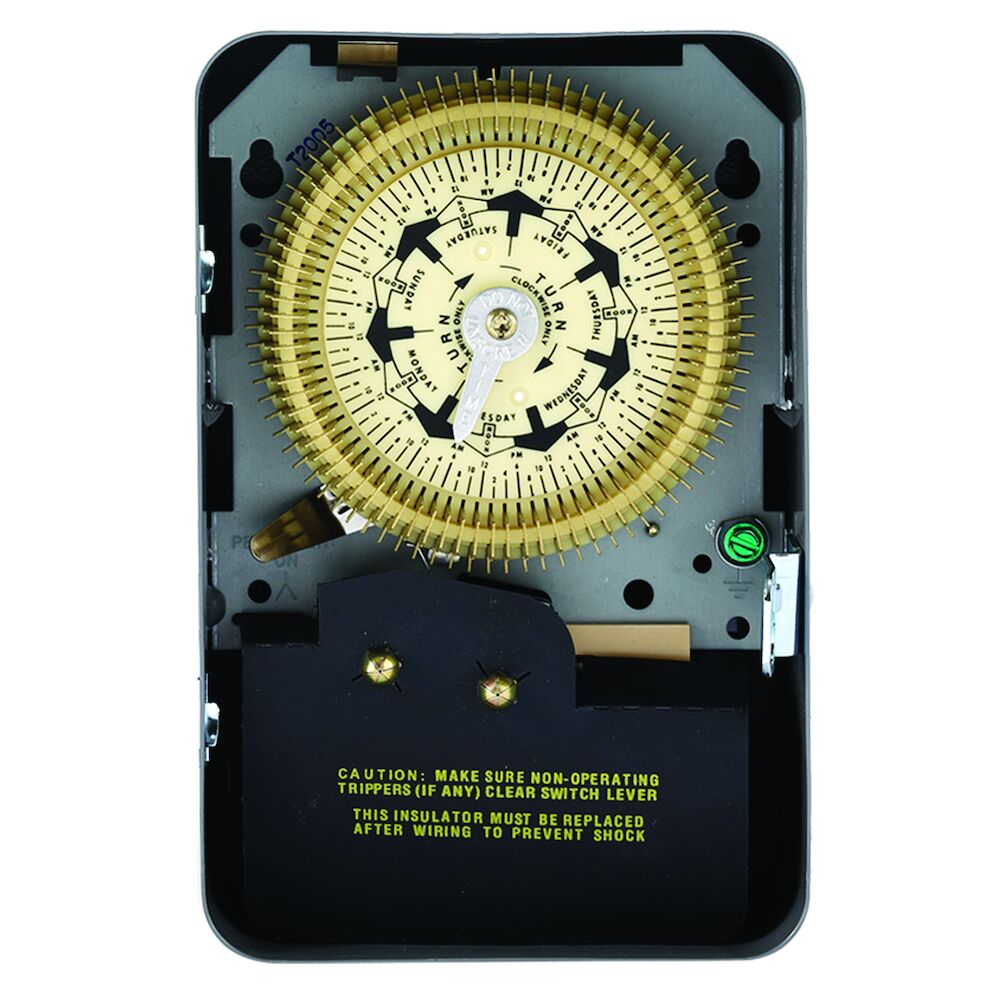
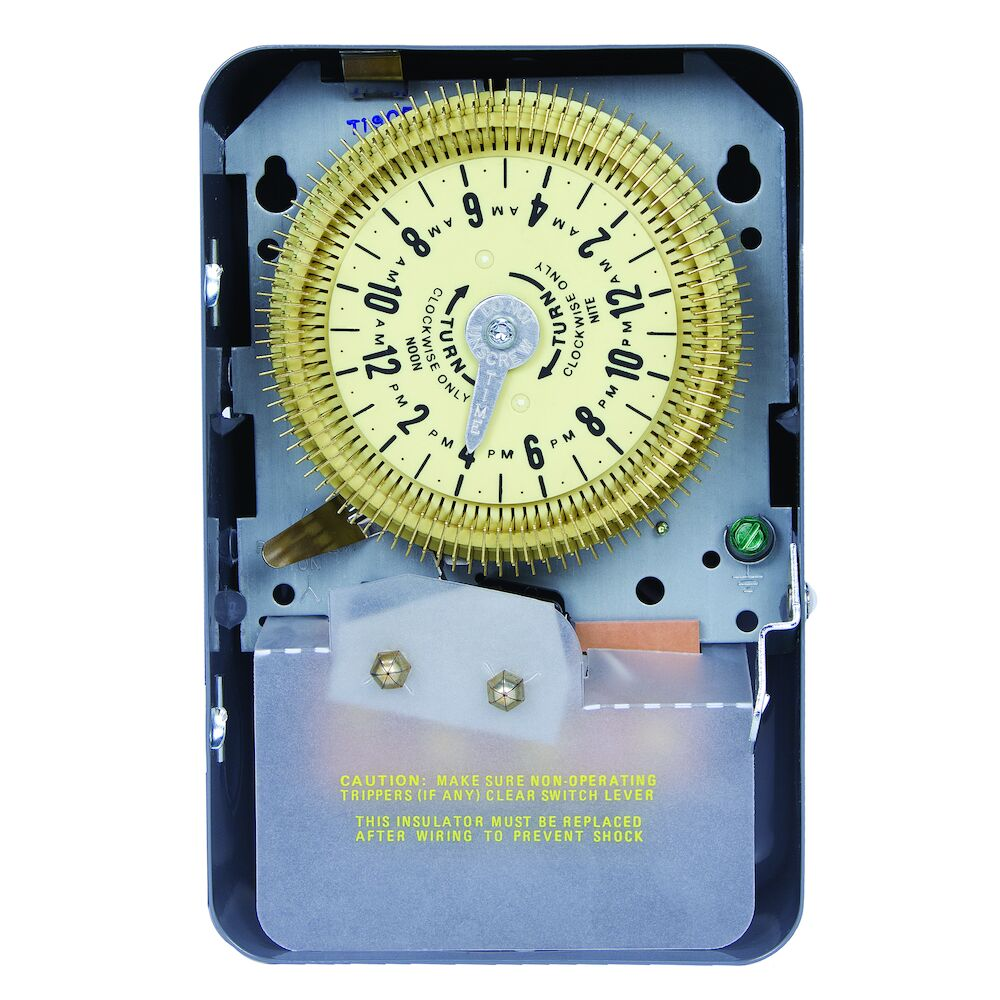
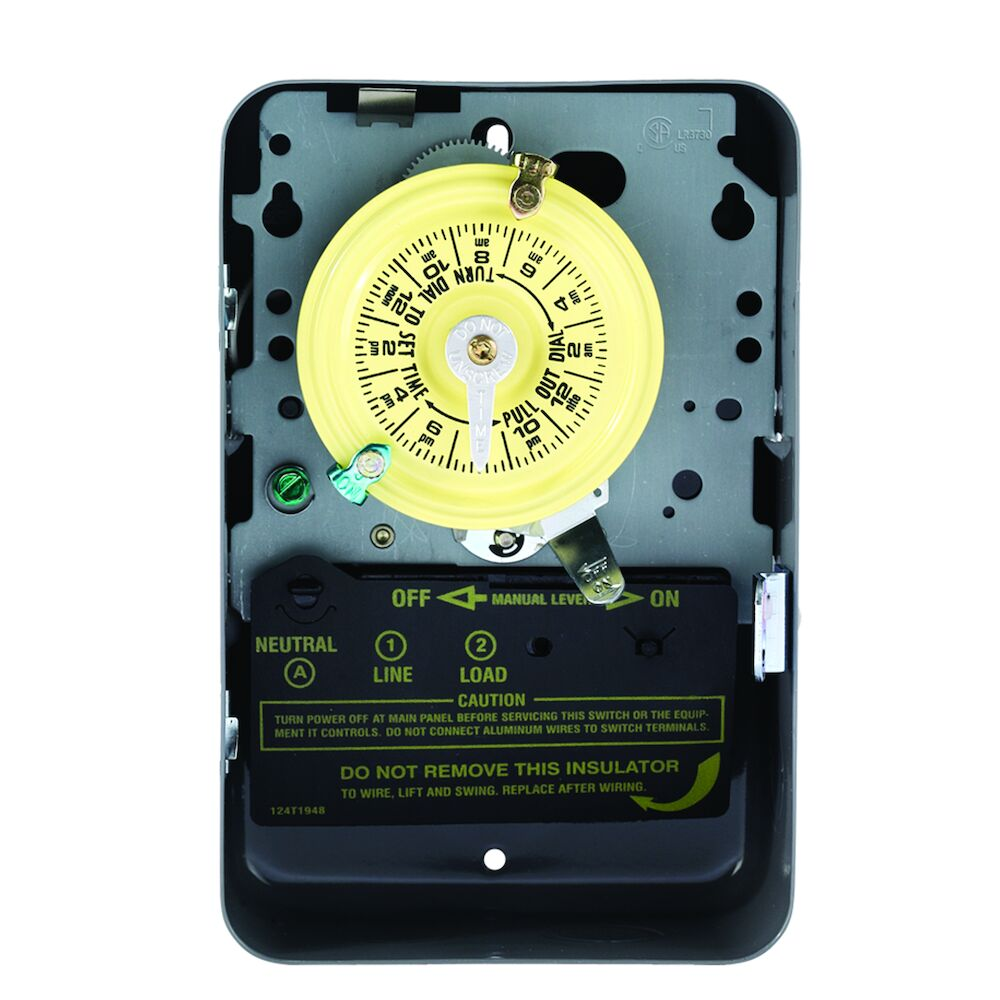
| Style | Model | Max. On/off Cycles | Min. Time Setting | Contact Form | Max. Time Setting | Enclosure Material | Depth | Number Of Poles | Number Of Trippers Included | Price (ex. VAT) | Cart |
|---|---|---|---|---|---|---|---|---|---|---|---|
| A | T7401B | 3 | 3.5 hrs. | SPST | 21 hrs. | - | 4" | 4 | 14 | 393.75 | |
| B | T7401BC | 3 | 3.5 hrs. | SPST | 21 hrs. | - | 4" | 4 | 14 | 1,243.30 | |
| C | T2005 | 6 | - | SPDT | 22 hrs. | - | 3" | 1 | 84 | 402.28 | |
| D | T1905E | 48 | 15 min. | SPDT | 23.75 hrs. | - | 3" | 1 | 96 | 259.17 | |
| E | T101 | 12 | 1 hr. | SPST | - | - | 3" | 1 | 2 | 138.98 | |
| F | T171 | 12 | 1 hr. | SPST | - | - | 3" | 1 | 2 | 234.06 | |
| G | T1905 | 48 | 15 min. | SPDT | 23.75 hrs. | - | 3" | 1 | 96 | 279.57 |
Explore Products
- REGAL 017902AS25 Hand Tap, 3 1/2-8 Size, H8 Limit, 6 Flutes, Plug, 8 Pitch With Tin Coating
- WEG ESWC-150T02NX-R49 Electronic Panel, 60Hp
- APPLETON ELECTRIC MLDL502G1GMT High Pressure Sodium Light Fixture, 50W
- MAXPURE TEG76L2.5-PC Tee, 316L Stainless Steel, Clamp x Clamp x Clamp
- KIPP K0269.51286X30 Adjustable Handles 1.18 M12 Green
- CLEVELAND C80425 Square End Mill, Center Cutting, 5 Flutes, 7/32 Inch Milling Dia, 3/4 Inch Length Of Cut
- HOFFMAN PPTHP78G 15573 Voice/Data And Server Cabinet Exhaust Vent/Fan, Fits 700 x 800mm Size, Gray
Explore More
- KEYSHAFT
- PELICAN
- XCELITE
- GAMBER-JOHNSON
- Water Suction and Discharge Hoses
- Impact Socket Adapters
- Spill Control Accessories
- Wire Marking Labels
- Pipe Picks
- FRIO-TEMP Thermometer
- PARKER 20 Series, Quick Coupler
- LENOX TOOLS Reciprocating Saw Blade Sets
- MORSE CUTTING TOOLS 5948 Series Double End Mills, 2-Flute Stub Length Ball Nose, Solid Carbide
- VALTERRA PVC Gate Valve, Spigot
- AKRO-MILS 30174 Shelf Bins
- CONDOR Heat Resistant Gloves, Cotton
- CONDOR Hemmed Inspection Women White Gloves
- ANVIL AS1000 Series EMT Conduit Clamps, Electro Galvanized
 Trade pricing is available for
  Order Value should be £500+
 ChatMRO