




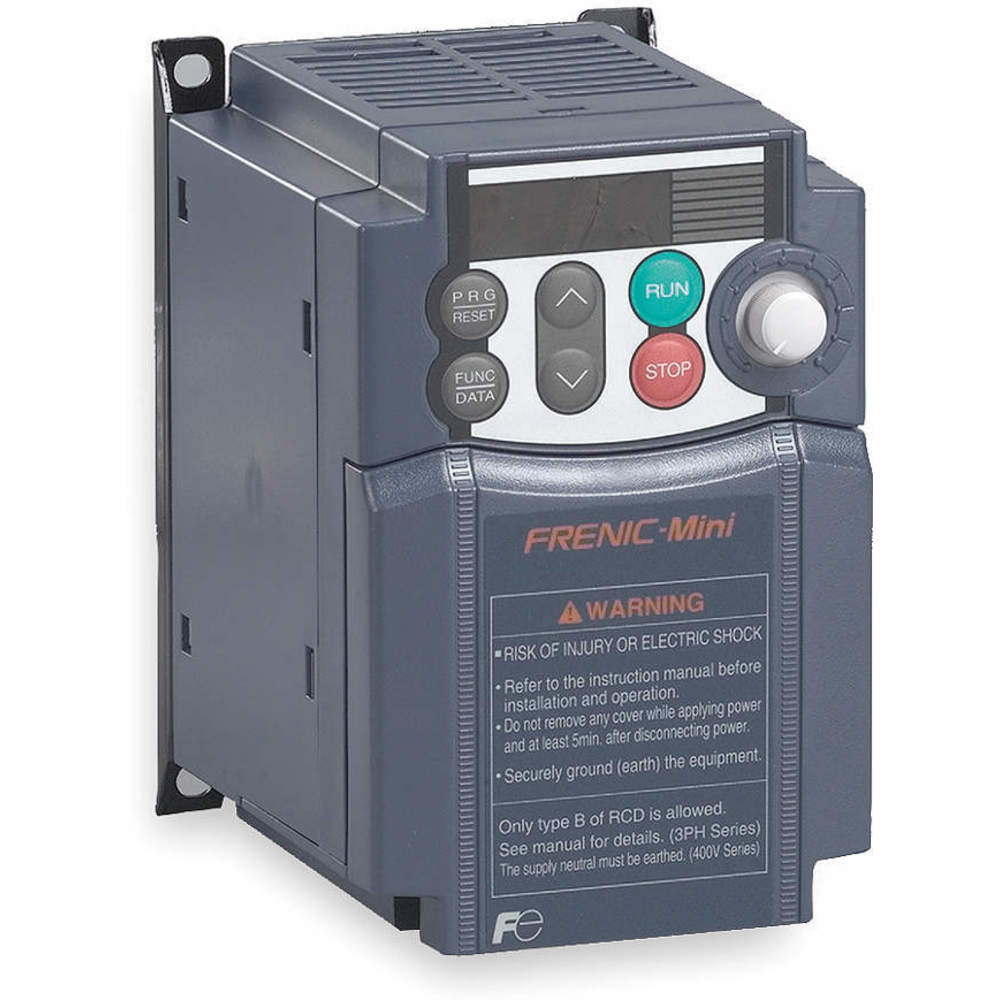
FUJI ELECTRIC FRN0012C2S-7U Variable Frequency Drive 3 Hp 200-230v
Item: AE4AXM
Model: FRN0012C2S-7U
18 In Stock
Ships within 2 days via
5.00% off
£464.41/unit
(Inc. VAT)
Trade Prices Available
Request Quote
Payment
- Specifications
- Product Details
- Shipping Information
- Uses
- Working Mechanism
- Features
- Compatible Accessories
- Standards and Approvals
- Installation
- FAQ′s
- See Variants
Specifications
| Item | Variable Frequency Drive |
|---|---|
| Adjustable Acceleration Time | 0 sec. to 3600 sec. |
| Adjustable Deceleration Time | 0 sec. to 3600 sec. |
| Application | Centrifugal Separators, Conveyors, Fans, Food Processing Machines, Pumps |
| Brake Chopper Included | Yes |
| Color | Blue |
| Control Method | Keypad |
| Control Type | Keypad |
| Depth | 5.47" |
| Digital Readout | Current, Frequency, Pid Operating Data, Speed, Voltage Output |
| Display Type | LED |
| Displays | LED |
| Dynamic Braking | Yes |
| Enclosure | Open |
| Enclosure Rating | NEMA 1 |
| Ethernet Port Included | No |
| Height | 7.09" |
| Input Frequency | 50/60 Hz |
| Input Phase | 1 |
| Input Phase Ac | 1 |
| Input Voltage | 230V AC |
| Input Voltage Range | 200-240V AC +/-10% |
| Max. Hp | 3 hp |
| Max. Output Amps | 12A |
| Maximum Output Power | 3 hp |
|---|---|
| Number Of Inputs | (5) Digital, (2) Analog |
| Number Of Outputs | (2) Digital, (1) Analog |
| Output Frequency | 50/60 Hz |
| Output Frequency Range | 0.1-400 Hz |
| Output Phase Ac | 3 |
| Output Type | Analog, Digital |
| Output Voltage | 200-240V AC |
| Output Voltage Range | 0-230V AC |
| Overall Depth | 5 1/2" |
| Overall Height | 7 1/8" |
| Overall Width | 5 1/2" |
| Protection | External alarm input, Ground fault, Input phase loss, Output phase loss detected, Overcurrent, Overheating, Overload, Overvoltage, Short-circuit, Undervoltage |
| Series | FRENIC MINI-C2 Series |
| Standard Logo | ul.png,ce.png |
| Start/stop Control | Programmable |
| Starting Torque | 150% |
| Style | Heat Sink |
| Torque @ 1 Hz | 150% |
| Torque Application | Constant Torque |
| Width | 5.51" |
| With Bypass / No Bypass | No Bypass |
| With Line Contactor / No Line Contactor | No Line Contactor |
| standard | CE, EN61800-5-1, UL 508C |
Product Details
Shipping Information
| Height | 15.75 |
|---|---|
| Length | 22.86 |
| Width | 19.05 |
| HS Code | 8504404000 |
|---|---|
| Country Of Origin | CN |
| Weight | 2.205000 |
Uses
Working Mechanism
- Variable frequency drives (VFDs) change the incoming alternating current (AC) into direct current (DC) and then use an inverter to convert the DC back into AC power at a different frequency.
- The frequency of the AC power can be adjusted using the inverter's switching rate.
- Users can increase the VFD's frequency to increase the speed of the motor and decrease the frequency to reduce the speed of the motor.
Features
- Fuji Electric FRN0012C2S-7U variable frequency drive features dynamic torque vector control, allowing precise power calculation based on motor load for optimal performance.
- It comes with an adjustable acceleration and deceleration time ranging from 0 to 3600 seconds, providing flexibility in motor speed control.
- This variable frequency drive offers a broad output frequency range from 0.1 to 400 Hz, catering to diverse industrial applications.
- It is equipped with a brake chopper, ensuring efficient braking capabilities for enhanced control during deceleration.
- It has an open enclosure with an overall depth of 5-1/2 inches and a compact design suitable for various installation environments.
- This variable frequency drive includes built-in protection mechanisms, such as external alarm input, ground fault detection, safeguarding against overcurrent, overheating and other potential issues.
Compatible Accessories
- Fuji Electric NEMA1-C2-301 AC Drive Kit: This NEMA 1 enclosure protects against dust and incidental contact, making it suitable for indoor applications. By seamlessly integrating with the VFD, this kit ensures a streamlined and reliable solution for motor speed control, contributing to efficient and optimised operations in industrial settings.
Standards and Approvals
Installation
FAQ′s
Q. What points should I consider for selecting a variable frequency drive?
A.
- Environment
- Speed range
- Speed variation allowed
- Torque requirements
- Acceleration time
- Duty cycle
Q. Why is a variable frequency drive required for a permanent magnet AC motor?
A. Permanent magnet motors reach full speed / torque almost immediately after actuation. The shock load by a normal power supply can often damage the connected mechanical components. The voltage supplied must be controlled. The VFDs play a big role here by matching motors with their respective power supply. However, users should not run more than 1 motor on a single variable frequency drive (VFD).
Related Products
| Style | Model | Input Phase | Output Voltage | Input Voltage | Start/stop Control | Height | Max. Hp | Depth | Overall Width | Price (ex. VAT) | Cart |
|---|---|---|---|---|---|---|---|---|---|---|---|
| A | FRN0001C2S-6U | 1 | - | 115V AC | Programmable | 4 18/25" | 1/8 hp | 3.94" | 3 1/8" | 233.50 | |
| A | FRN0002C2S-6U | 1 | 200-240V AC | 115V AC | Programmable | 4 18/25" | 1/4 hp | 3.94" | 3 1/8" | 235.99 | |
| A | FRN0003C2S-6U | 1 | - | 115V AC | Programmable | 4 18/25" | 1/2 hp | 4.53" | 3 1/8" | 263.32 | |
| A | FRN0002C2S-4U | 3 | 380-480V AC | 460V AC | Programmable | 5 3/25" | 1/2 hp | 4.53" | 4 3/8" | 355.22 | |
| A | FRN0004C2S-4U | 3 | 380-480V AC | 460V AC | Programmable | 5 3/25" | 1 hp | 5.47" | 4 3/8" | 372.61 | |
| A | FRN0005C2S-4U | 3 | 380-460V AC | - | Programmable | 5 3/25" | 2 hp | 5.47" | 4 3/8" | 424.78 | |
| A | FRN0007C2S-4U | 3 | 380-460V AC | - | Programmable | - | 3 hp | - | 4 3/8" | 459.56 |
Explore Products
- HAMMOND RDRW1900712BK1 Locking Rack Drawer, 19 Inch Rack Width, 12.25 Inch Depth, Carbon Steel, Black
- RUBBERMAID GRFG4532L20000 Swivel Caster
- BUSSMANN 10NHG000B-690 High Rupture Cartridge Fuse, Slow Blow, 10A, 690VAC
- MAIN FILTER INC. MF0585664 HF35113 Interchange Hydraulic Filter, Cellulose, 10 Micron, Buna Seal, 11.81 Inch Height
- SURE GEAR PGB070-10A1 High-Precision Planetary Gearbox, 10:1 Ratio, Right Angle, 16mm Dia. Output Shaft
- APPROVED VENDOR SF3216IP Drill Bushing Type Slip Fixed Drill Size 8.1mm
- MILWAUKEE VALVE HW234V Butterfly Valve, 2 Inch Pipe Size, Concentric, 250 psi Max Pressure, Wafer, FKM
- CONRADER 4488-OUT Fitting, Inverted SAE Flare, 1/2 Inch Size
Explore More
- KEYSHAFT
- NOBLES
- OMNITEC
- PHILIPS BURTON
- INSTOCK
- Kitchen Faucets
- Label Applicators
- Keychain and Mini Flashlights
- High Bay Occupancy Sensors
- Antistatic Cords
- SPEARS VALVES CPVC True Union 2000 Industrial 3-Way Horizontal Diverter Ball Valves Regular Style, Socket, FKM
- SPEARS VALVES Butterfly Valve CPVC True Lug Valve Overhaul Kits With Disc, Buna-N
- CHAMPION TOOL STORAGE CNC Modular Cabinets
- ICS Pipes
- HUBBELL WIRING DEVICE-KELLEMS Variload Twist-Lock Plugs
- AMERIC Duct To Duct Connectors, 5.375 Inch Length
- CONDOR Coated Gloves, ANSI Cut Level A2, Palm Dipped, Polyurethane, White
- DESTACO 334-R Series Pull Action Latch Clamps
- PROTO Impact Socket, 6 Point, 3/8 Inch Drive, Metric
- KEO Countersink Sets, Carbide
 Trade pricing is available for
  Order Value should be £500+
 ChatMRO